NASA's James Webb Space Telescope Discovers New Moon Of Uranus
 More details: Found here
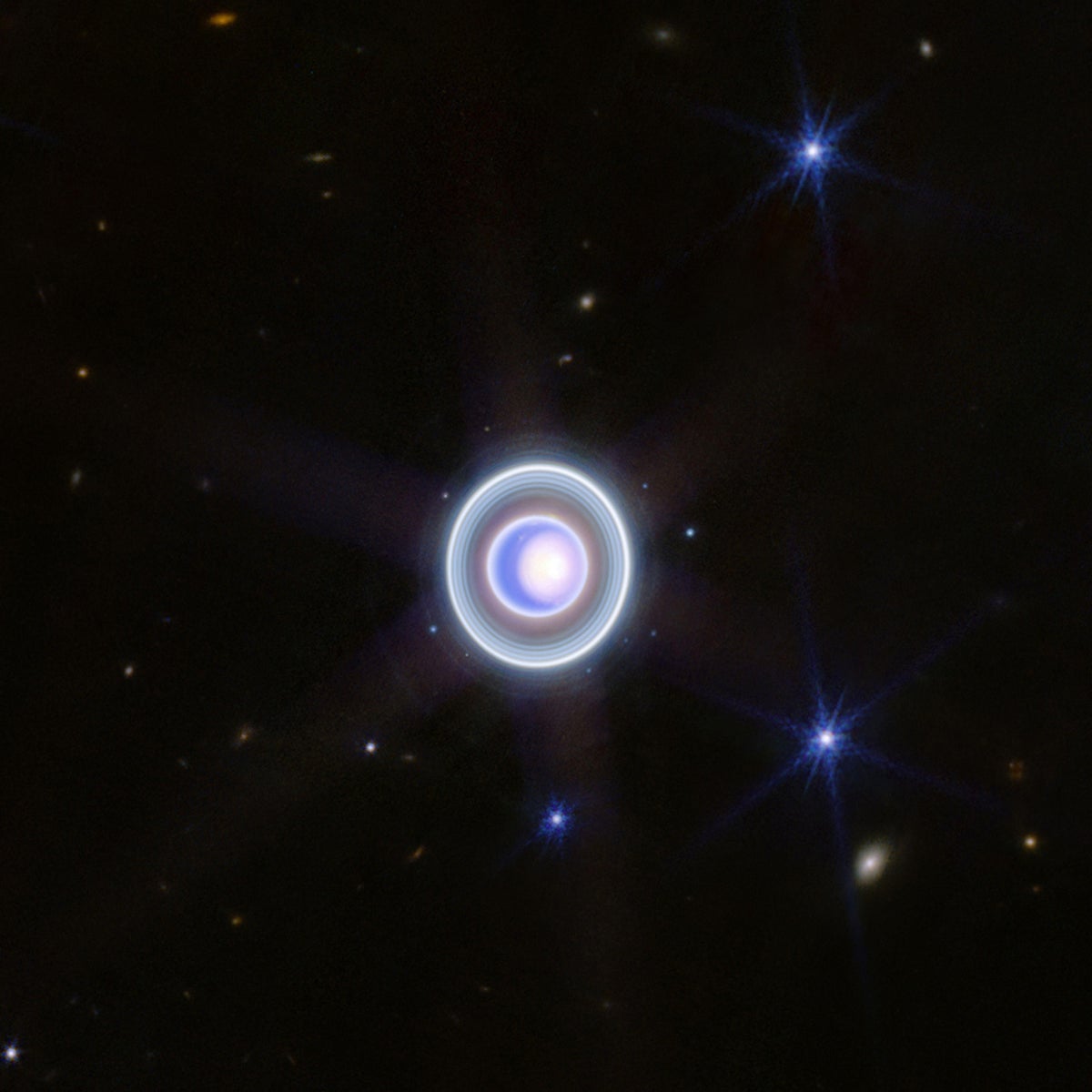
Using the powerful James Webb Space Telescope, scientists have spotted a moon nestled near Uranus⁘s rings that⁘s so small you could walk around it
Scientists have discovered a new, elusive moon around Uranus, making it the 29th natural satellite known to orbit the ice giant .
The research team that made the discovery estimates that the moon, dubbed S/2025 U1 for now (at least, until the International Astronomical Union assigns an official name), is just 10 kilometers, or six miles, across, making it particularly small.
⁘I could walk around this moon,⁘ says Heidi Hammel, a planetary scientist and astrophysicist, who was not involved in the research.
A team led by the Southwest Research Institute detected the moon in images captured by the high-resolution Near-Infrared Camera on the James Webb Space Telescope (JWST) during a series of 10 40-minute-long exposures. ⁘The cameras on [JWST] are very sensitive,⁘ Hammel says.
⁘They were designed to see the faintest galaxies in the universe,⁘ as well as faint things that are close to very bright ones (such as the planet Uranus). NASA announced the moon⁘s discovery today via a blog post.
There are still many questions about the new minuscule moon for astronomers to explore: How does it compare with other moons?
What is its color and composition? JWST might help answer a few of these questions. But regardless of what comes next, the discovery shows ⁘how we can extend the horizons of our knowledge, even in our own solar system, using an advanced telescope like JWST,⁘ Hammel says. ⁘And it helps us get a better understanding of what drives the phenomena in our solar system⁘like ⁘⁘What is crafting that ring system around the planet Uranus?⁘⁘


Comments
Post a Comment