How Did A Planet This Big Form Around A Star This Small?
 Source: Visit website
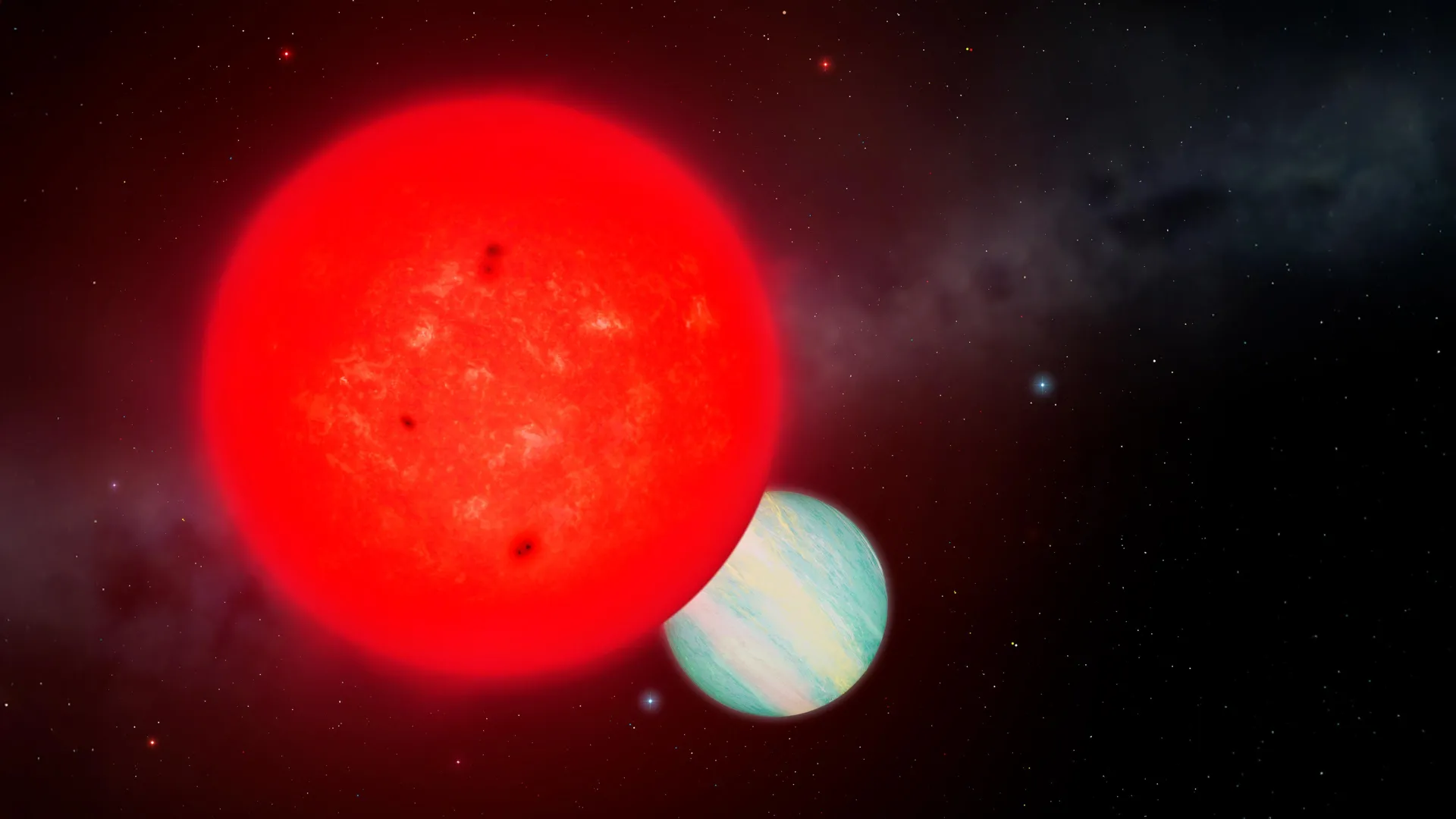
 The host star, TOI-6894, is a red dwarf with only 20% the mass of the Sun, typical of the most common stars in our galaxy. Until now, such low-mass stars were not thought capable of forming or retaining giant planets.
But as published recently in Nature Astronomy , the unmistakable signature of a giant planet -- TOI-6894b -- has been detected in orbit around this tiny star.
This exceptional system was first identified in data from NASA's Transiting Exoplanet Survey Satellite (TESS), as part of a large search for giant planets around small stars, led by Dr. Edward Bryant from UCL's Mullard Space Science Laboratory.
The planetary nature of the signal was then confirmed by an extensive ground-based observation campaign, involving several telescopes -- including those of the SPECULOOS and TRAPPIST projects, both led by the University of Li⁘ge.
Dr. Khalid Barkaoui, researcher on the SPECULOOS and TRAPPIST teams, oversaw these crucial follow-up observations. He explained: ⁘The transit signal was unambiguous in our data.
Our analysis ruled out all alternative explanations -- the only viable scenario was that this tiny star hosts a Saturn-sized planet with an orbital period of just over three days. Additional observations confirmed that its mass is about half that of Saturn. This is clearly a giant planet.⁘
Prof. Jamila Chouquar, who was an astronomer at ULiege at the time of the discovery, added: ⁘We previously believed that stars this small couldn't form or hold on to giant planets.
But stars like TOI-6894 are the most common type in the Milky Way -- so our discovery suggests there may be far more giant planets out there than we thought.⁘


Comments
Post a Comment