NextBigFuture.Com
 Source: Found here
 A team led by Amos Chen from the National Tsing Hua University, is searching for Planet Nine's heat signature. When you double the distance from the sun, reflected light becomes 16 times fainter. This is an inverse fourth-power relationship. But thermal radiation, the heat that all objects naturally emit, only becomes four times fainter when you double the distance.
They used far infrared light data from AKARI, a Japanese space telescope. Unlike ground-based telescopes that are hampered by Earth's atmosphere, AKARI could detect the faint thermal glow that Planet Nine should emit.
Planet Nine was estimated to have a temperature range between 53 and 28 K. Only requiring AKARI detection can expand the search to five times fainter objects than a previous survey.
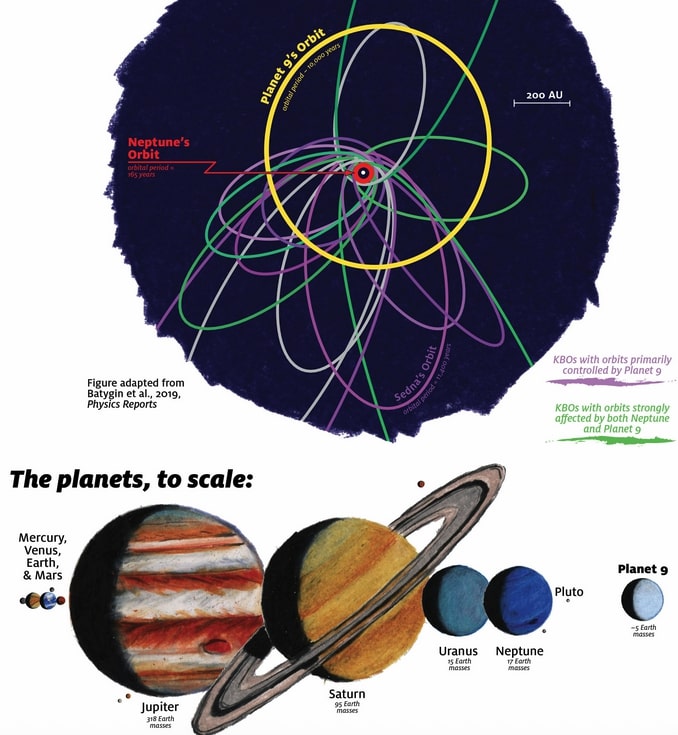
They looked at specific regions of sky where computer simulations suggested Planet Nine was most likely to be found, based upon the orbital patterns of the Kuiper Belt Objects. They then faced the challenging task of distinguishing a slowly moving planet from the countless stars, galaxies, and cosmic debris that populate this region.
Planet Nine should appear stationary over the course of a single day but show detectable movement over months.
The noise fluctuation could also contribute to fake sources. They assume FISSSDL sources that were detected only once are not real sources. Because Planet Nine selection criteria require at least two hourly detections, they estimated the chance of two bright singly detected sources overlapping.
Follow-up observations will be essential to verify the Planet Nine hypothesis. The confirmation of Planet Nine and its orbit might be able to explain the orbital clustering of KBOs, which helps us to have a deeper understanding of the solar system's history.


Comments
Post a Comment