Giant Space 'Boulders' Unleashed By NASA's DART Mission Aren't Behaving As Expected, Revealing...
 Read more: Found here
 Three years ago, NASA made history by deliberately smashing a spacecraft into a large asteroid , altering its course and demonstrating humankind⁘s ability to protect our planet from "potentially hazardous" space rocks in the future.
But a new analysis hints that the debris from this monumental collision is not behaving as expected, raising doubts about the success of future asteroid-deflecting missions.
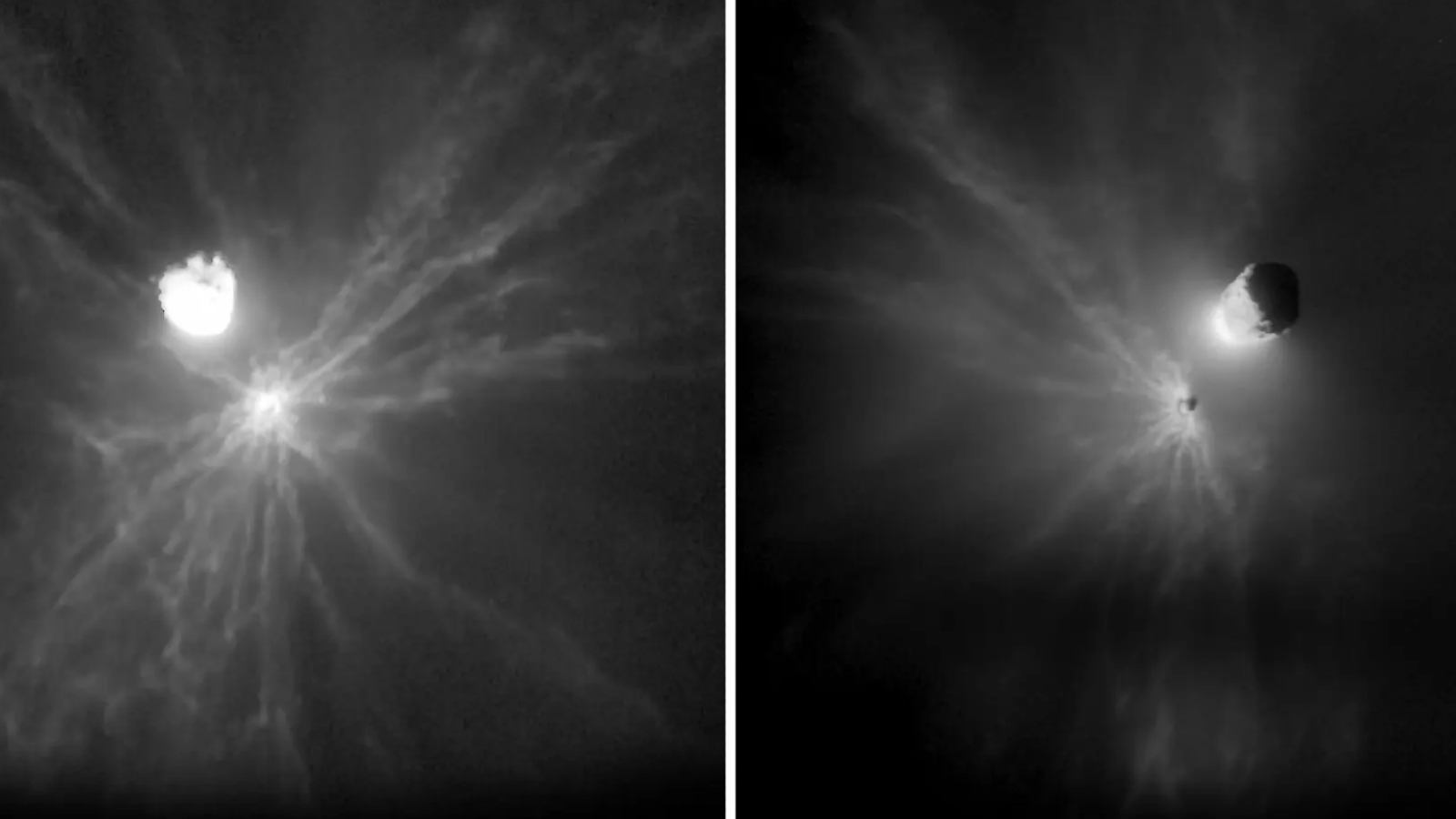
On Sept. 26, 2022, NASA's Double Asteroid Redirection Test (DART) spacecraft purposefully collided with the asteroid Dimorphos, crashing directly into the middle of the space rock at around 15,000 mph (24,000 km/h). The mission was a smashing success : Not only did DART alter Dimorphos' trajectory ⁘ shortening its trip around its partner asteroid Didymos by around 30 minutes ⁘ it also completely changed the shape of the asteroid.
The collision, which occurred more than 7 million miles (11 million kilometers) from Earth, demonstrated that this type of action, known as the "kinetic impactor" method, was a conceivably viable option for protecting our planet from potentially hazardous asteroids.
However, a new study, published July 4 in The Planetary Science Journal , has revealed a hidden complication: Dozens of large " boulders ," which were knocked loose from the asteroid by the spacecraft are apparently traveling with greater momentum than predicted and have configured into surprisingly non-random patterns.
The researchers analyzed images from the European Space Agency 's (ESA) Light Italian Cubesat for Imaging of Asteroids (LICIACube), which flew alongside DART to monitor the collision.
This allowed them to track 104 boulders ⁘ each between 0.7 and 11.8 feet (0.2 to 3.6 meters) across ⁘ as they shot away from the asteroid.
The team also noted that the boulders were arranged into unexpected patterns: "We saw that the boulders weren't scattered randomly in space," Farnham said. "Instead, they were clustered in two pretty distinct groups, with an absence of material elsewhere, which means that something unknown is at work here."


Comments
Post a Comment