Astronomers Discover 'Ammonite,' A Mysterious Distant Object That Could Shed Light On Ou...
 Read more: Visit website
Nicknamed Ammonite, the recently discovered sednoid has a perihelion of 66 astronomical units (AU). One AU is the approximate distance between the Earth and sun—around 93 million miles. Ammonite's semi-major axis , or its average distance from the sun, is 252 AU.
Objects with orbits like Ammonite's "are challenging to observe, and thus their detections are still rare, yet they play a crucial role in constraining models of solar system formation," the researchers write in the paper.
"The significance of discovering Ammonite goes far beyond adding one more distant object," Shiang-Yu Wang , the study's corresponding author and a research fellow at the Academia Sinica Institute of Astronomy and Astrophysics in Taiwan, says in a statement . "Ammonite's orbit tells us that something sculpted the outer solar system very early on.
Whether it was a passing star or a hidden planet, this discovery brings us closer to the truth."
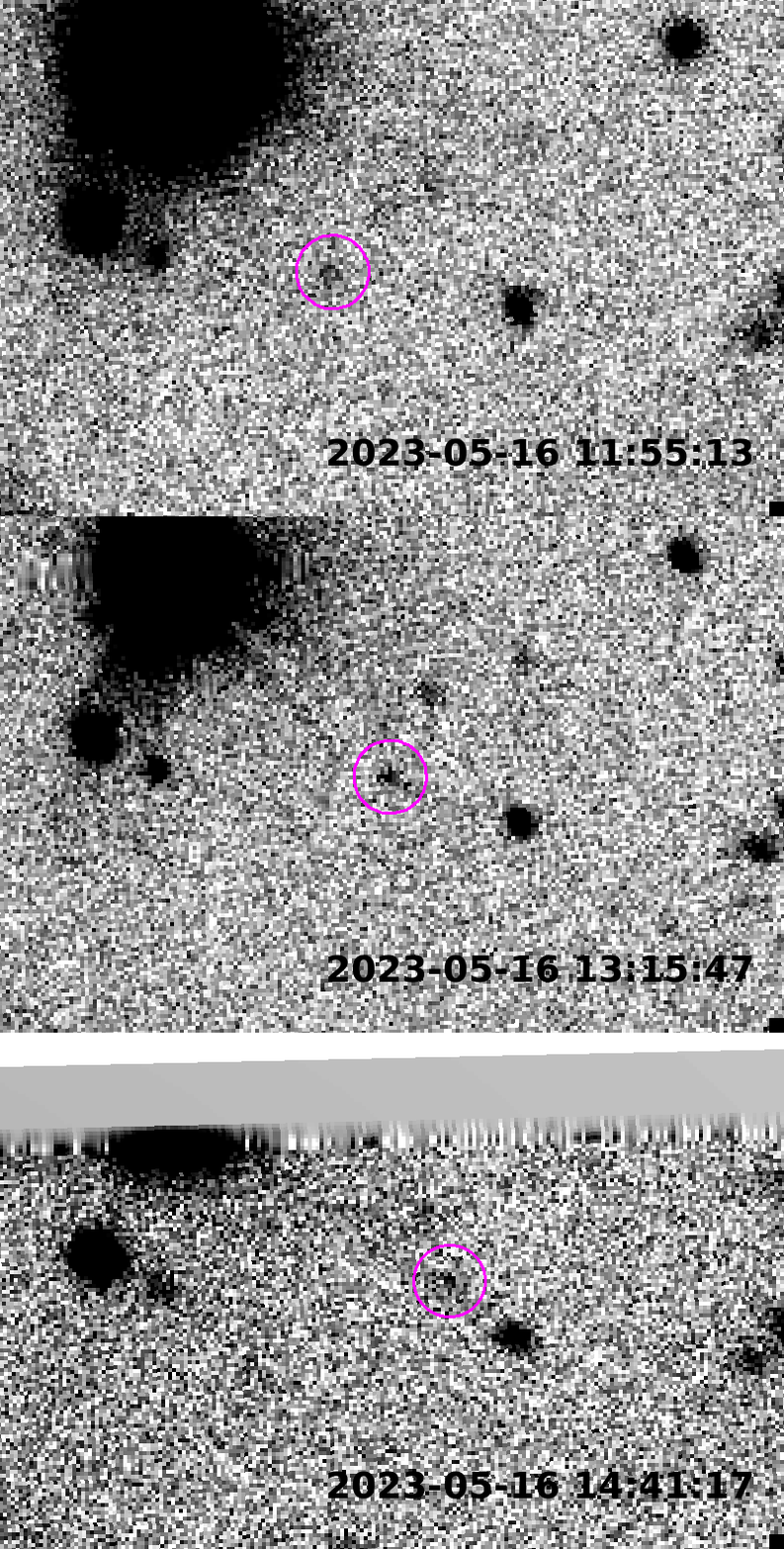
Astronomers found Ammonite through Subaru Telescope observations as part of a survey project called FOSSIL (Formation of the Outer Solar System: an Icy Legacy). The team followed up the initial observations from March, May and August 2023 with more observations from the Canada-France-Hawaii Telescope in July 2024.
"It takes about a year of observing to determine whether an orbit is Sedna-like or not," Scott Sheppard , an astronomer at the Carnegie Institution for Science, told NBC News in 2014 after co-discovering 2012 VP113, the second sednoid identified.
The team from the recent study, though, was able to trace Ammonite's orbit across 19 years by retroactively identifying it in archival data from other observatories.
Sednoids play a strong supporting role in the Planet Nine theory, which argues that a giant ninth planet, sometimes referred to as Planet X , exists in our solar system beyond Neptune. That's because these distant objects have strangely aligned orbits that may indicate the gravitational influence of an undiscovered planet, per Gizmodo 's Passant Rabie.


Comments
Post a Comment