Webb Space Telescope Reveals Starburst Galaxies That Lit Up The Early Universe
 More details: See here
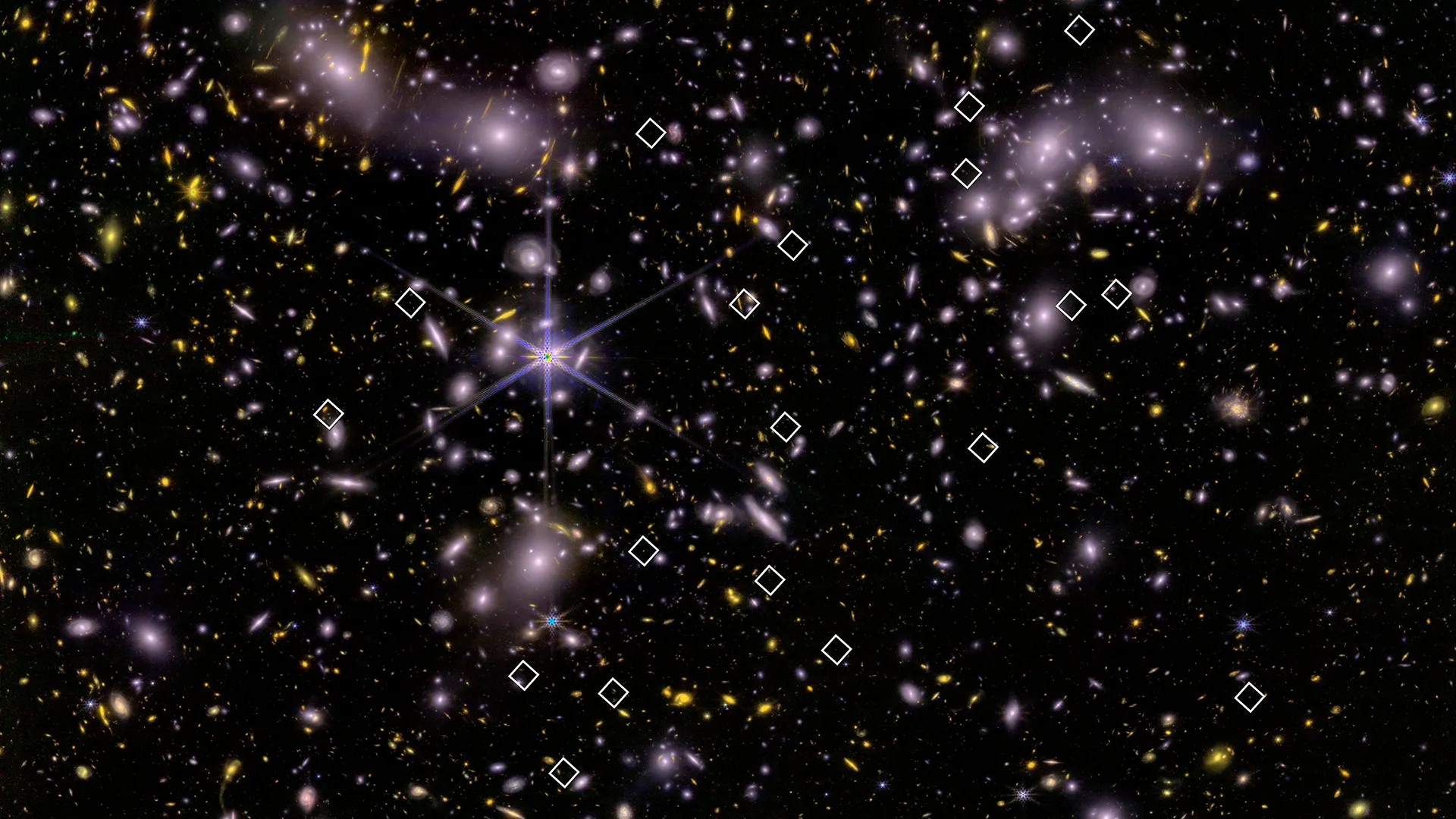
 Astronomers using data from NASA's James Webb Space Telescope have identified dozens of small galaxies that played a starring role in a cosmic makeover that transformed the early universe into the one we know today.
"When it comes to producing ultraviolet light, these small galaxies punch well above their weight," said Isak Wold, an assistant research scientist at Catholic University of America in Washington and NASA's Goddard Space Flight Center in Greenbelt, Maryland. "Our analysis of these tiny but mighty galaxies is 10 times more sensitive than previous studies, and shows they existed in sufficient numbers and packed enough ultraviolet power to drive this cosmic renovation."
Wold discussed his findings Wednesday at the 246th meeting of the American Astronomical Society in Anchorage, Alaska. The study took advantage of existing imaging collected by Webb's NIRCam (Near-Infrared Camera) instrument, as well as new observations made with its NIRSpec (Near-Infrared Spectrograph) instrument.
The tiny galaxies were discovered by Wold and his Goddard colleagues, Sangeeta Malhotra and James Rhoads, by sifting through Webb images captured as part of the UNCOVER (Ultradeep NIRSpec and NIRCam ObserVations before the Epoch of Reionization) observing program, led by Rachel Bezanson at the University of Pittsburgh in Pennsylvania.
The project mapped a giant galaxy cluster known as Abell 2744, nicknamed Pandora's cluster, located about 4 billion light-years away in the southern constellation Sculptor. The cluster's mass forms a gravitational lens that magnifies distant sources, adding to Webb's already considerable reach.
For much of its first billion years, the universe was immersed in a fog of neutral hydrogen gas. Today, this gas is ionized -- stripped of its electrons. Astronomers, who refer to this transformation as reionization, have long wondered which types of objects were most responsible: big galaxies, small galaxies, or supermassive black holes in active galaxies.
As one of its main goals, NASA's Webb was specifically designed to address key questions about this major transition in the history of the universe.


Comments
Post a Comment