The Tallest Mountain In The Solar System Isn't On Earth
 Source: Visit website
Mount Everest, one of the go-to examples of a "thing that is large", looks like a tiny hillock in comparison to other mountains of the Solar System.
While Everest stands at 8,849 meters (29,032 feet) tall, the two tallest mountains orbiting the Sun reach over 20,000 meters (65,600 feet) in elevation.
The second-tallest mountain structure lies not on a planet, but on Iapetus, one of Saturn's ridiculous number of moons . This tidally-locked moon is notable for the stark difference between its hemispheres, with one side much darker than the other.
"The second most notable feature of Iapetus is its 'equatorial ridge,' a chain of 6-mile (10-km) high mountains girdling the moon's equator. On the anti-Saturnian side of Iapetus, the ridge appears to break up and distinct, partially bright mountains are observed.
The Voyager I and Voyager II encounters provided the first knowledge of these mountains, and they are informally referred to as the Voyager Mountains," NASA explains .
"There are two theories on how the ridge formed. Some scientists think the ridge was formed at an earlier time when Iapetus rotated much faster than it does today; others think the ridge is made of material left from the collapse of a ring."
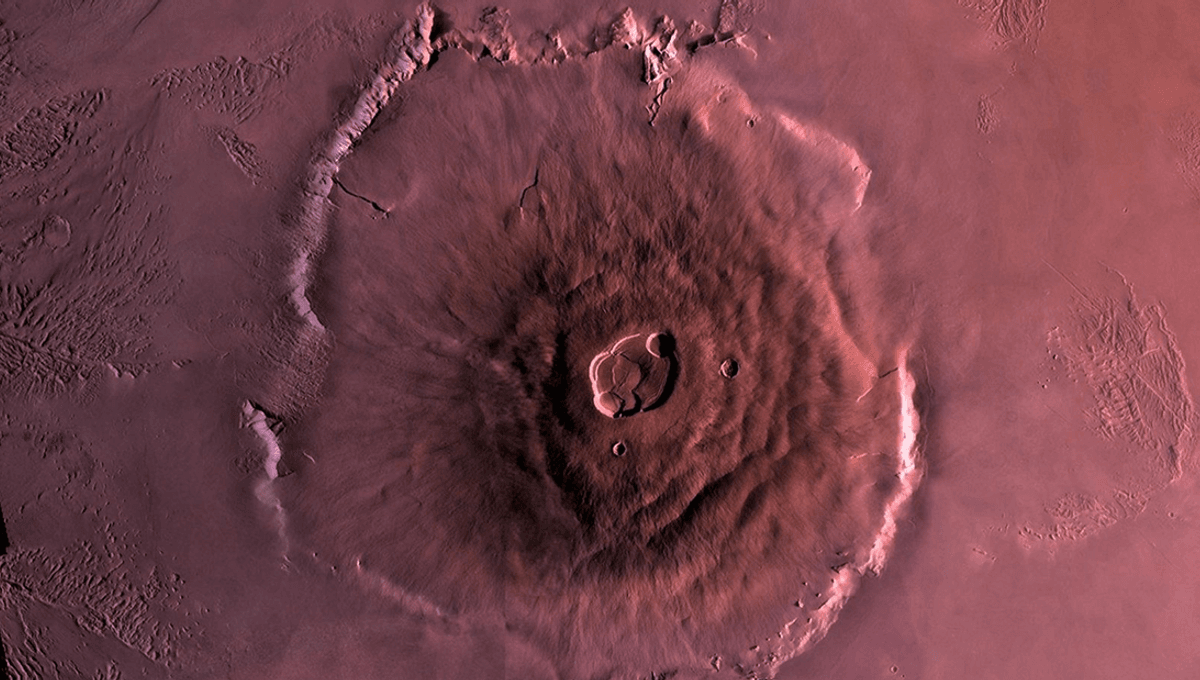
At its highest, the ridge reaches around 20 kilometers (12.4 miles). Olympus Mons, on Mars, is taller still, at 40 kilometers (25 miles) from base to summit .
The mountain is a shield volcano , a type of volcano built up from repeated lava flows over millions of years, as basaltic and/or andesitic lava pours down the volcano's side. As a result, Olympus Mons has a base covering an area around the size of Arizona, and an average slope of around 5 percent .
Intriguingly, the volcano may still be active, and may even erupt again in the future.
Recently, seismometers on Mars have detected activity from the region, while geological evidence suggests that the volcano has been active in the recent geological past.


Comments
Post a Comment