These Are The Sharpest Images Yet Of Planets Being Born Around Distant Stars
 More details: See here
Astronomers have captured the sharpest, most detailed images yet of young solar systems where planets are just beginning to take shape.
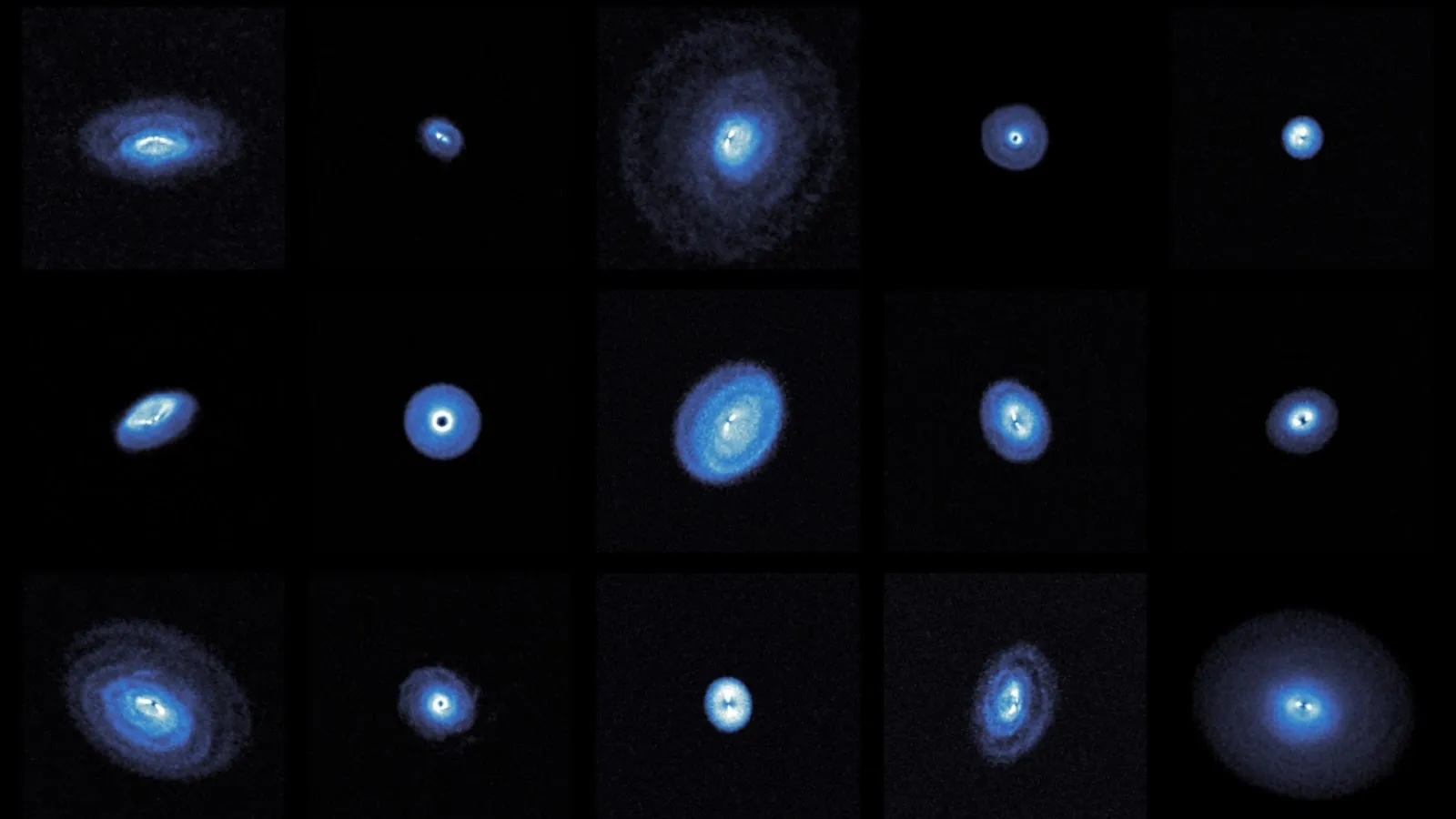
Exquisite snapshots released on April 28 provide a rare glimpse into the earliest stages of planet formation in more than a dozen star systems, revealing where planets emerge, how quickly they form and what materials they're made from. Scientists say the data could help refine computer models of planetary formation and evolution, as well as shed new light on how these infant systems compare to the myriad of mature exoplanets already discovered.
The high-resolution, science-packed images come thanks to advanced imaging techniques courtesy of the Atacama Large Millimeter/submillimeter Array (ALMA) in Chile. These techniques reduce distortions and sharpen clarity, boosting astronomers' ability to map out the planet formation process with greater precision by revealing finer structures within the protoplanetary disks ⁘ the swirling gas and dust surrounding young stars, according to a statement .
The newly developed techniques "are like switching from reading glasses to high-powered binoculars," Richard Teague of the Massachusetts Institute of Technology, who serves as the principal investigator of the project, said in the statement. "They reveal a whole new level of detail in these planet-forming systems."
Using ALMA, Teague's team captured images of 15 young star systems sprinkled in space between a few hundred to 1,000 light-years from Earth. Rather than rely on direct detection of a young planet's faint light, Teague's team looked for the subtle clues these infant worlds imprint on their surroundings ⁘ such as gaps and rings in dusty disks, swirling gas motions caused by a planet's gravity, and other physical disturbances that hint at a planet's presence. To uncover these signatures, the researchers used ALMA to map the motion of gas within over a dozen protoplanetary disks.
"It's like trying to spot a fish by looking for ripples in a pond, rather than trying to see the fish itself," Christophe Pinte, an astrophysicist at the Institute for Planetary sciences and Astrophysics in France, who was also a principal investigator of the project, said in the statement.


Comments
Post a Comment